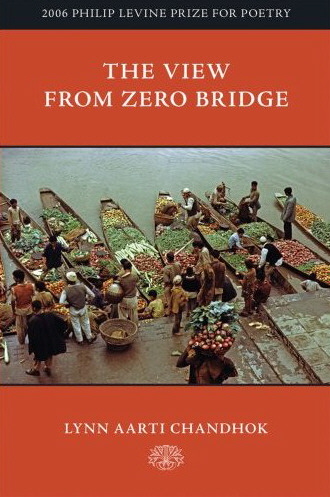
Lynn Aarti Chandhok. The View from Zero Bridge. Tallahassee, Florida: Anhinga Press, 2007. $14.00 paper (ISBN 978-0-938078-98-2), 77 pages.
Reviewed by Jenny Burdge
Lynn Aarti Chandhok’s debut collection of poetry, The View from Zero Bridge, is gorgeous. The poems work their truths, half-truths, and debatable facts through both the magic of sensual detail and words and phrases crafted into rhythms and rhymes usually so subtle, you often only awaken to their power by the end of the poem, when Chandhok wants you to know that yes, you’ve been under a spell, and perhaps you should question the veracity of everything the poem has told you, everything you’ve ever been told.
Chandhok was born in Pittsburgh, and raised there as well, but she spent many summers as a child in Kashmir with her father’s family. This upbringing in more than one place, more than one culture, echoes through the book’s situations and motifs, but dealing with multicultural existence is not, per se, the book’s theme.
From the cover image and title and through the poems themselves, the book announces itself as one concerned with place (Zero Bridge) but also perspective (the view). After reading Chandhok’s note regarding the cover, it also becomes clear that the book is concerned with just what we consider fact in the first place. Chandhok says, “Like many of the ‘facts’ in this book, the title itself is wrong.” That is because, although Chandhok somehow came to understand that the cover image, a photograph taken by her father, was taken from Zero Bridge, she finally learned in 2007 that this couldn’t have been the case, for there is no boat landing under that bridge.
The idea of truth, then, amongst all the book’s other concerns, is primary. In this way, an epigraph by Derek Mahon serves as the bottle of champagne for this book’s maiden voyage—both thematically and formally. It reads:
Ah, but words on the page aren’t the whole story
for all my hopes and fears are fictions, too
and I live in a virtual fever of creation—
the whole course of my life has been imagination,
my days a dream; when we wake from history
may we find peace in the substance of the true.
So, often being incapable of knowing truth—that “whole story”—the hope is that we can be satisfied with its substance—the essence of truth, which we still find ourselves unsure of, given the delusion of history; that is, the stories we’ve been told and the stories that we’ve read are untrustworthy, and only when we recognize this can we find something essentially true. This essence of truth is difficult and troubling, as the first poem, “Marketplace” (set in Kashmir, 1999), expresses:
My loss is trivial: a childhood home
to which return would be a senseless risk
just to confirm that paradise was real.
…
On either side, the only truth is loss,
and blame is strewn like wreckage or debris,
the storylines, disputed maps, redrawn.
Through all five of the book’s sections, this difficulty and trouble of knowing truth is returned to, rehashed, reestablished. In a sonnet of two septets titled “Brooklyn Botanic Garden, 10/01,” the speaker encounters a woman painting the staged nature “as if it’s not / already art, or dream, or plan, or real.” In another sonnet, “Trust,” the speaker says, “We’ve pulled it off again,” and then remembers dreaming frightening fires as a child, which she’d been told could happen, then concludes: “I’m undone by what children believe: / the ones who dream of martyrdom, or mine— / who trust that what I tell them is the truth.” In “Revision: the Bandh,” the speaker revisits a poem that appears early in the book, realizing the memory that occasioned the earlier poem was imagination: “Was it a dream or vision that such lengths / could spread themselves, so beautifully, on the banks?” In a number of elegies, that “only truth,” loss, is even more direct. It becomes clear that this “only truth” is what unites us, in spite of ourselves, in spite of whatever “blame is strewn like wreckage or debris.”
The poems in this collection do not, however, dismiss the delusion or illusions of history as being without value. The longest poem of the book, and perhaps my favorite, spreads out over the book’s middle. “The Story of the Palace,” set in Fatehpur Sikri, April 2001, is formally more intricate than the other poems. It is written in iambic pentameter, just as almost all the others in this book are; however, with its lines being broken, either mid-line or with the more usual enjambment, the meter is more difficult to detect. Similarly, rhymes, both true and slant, weave subtly through the poem, sometimes with the chiming word at a distance from its partner. These weavings are a reminder of the book’s epigraph (both formally and thematically), and they imitate the intricate and broken threads of which history and stories are also woven. The poem tries to find the true story of the title palace, but the speaker’s guidebook, stories she heard on an earlier visit, and the stories her guide tells her during the current visit often diverge. There is no way to know the truth, no way to know what pieces of it to trust. A line from the guidebook describing the palace applies just as well to the stories of it: “Its parts are better than the whole.” What this poem suggests, then, contradicts the book’s epigraph.
Perhaps we can’t find peace in the substance of the truth, because we may never see what that is. Perhaps peace comes in viewing all the diverging parts of history’s dream, hoping one of those parts is true, while delighting in all the others.