Dear Bluelight readers,
We are taking a few weeks off from blogging as we close up shop for winter break. But before we go, we wanted to leave you with a present. Mark Holden, author of the short story, "New Baby" has honored us with a reading of this story. It will be appearing in issue 32.2 which should be hitting shelves and mailboxes sometime within the month. Every time I read this story it gives me chills. Enjoy!
If you haven't ordered your copy of 32.2 yet. It's not to late. Just click here.
p.s. Thanks to our tech-savvy intern Tara, you should be able to find the podcast via iTunes. & you can subscribe to the podcast at: http://inreview.podbean.com/feed

Friday, December 10, 2010


Wednesday, December 8, 2010
Review from 32.1
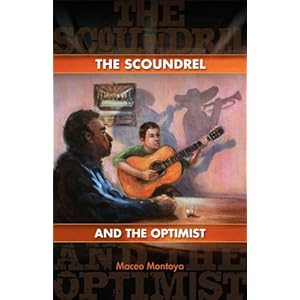 Maceo Montoya. The Scoundrel and the Optimist. Tempe, Arizona: Bilingual Review Press, 2009. $28 cloth (ISBN 978-1-931010-65-8), $18 paper (ISBN 978-1-931010-67-2), 266 pages.
Reviewed by Bradley Bazzle
Maceo Montoya’s debut novel, The Scoundrel and the Optimist, is about a runty teenager named Edmund (the optimist) and his drunken lout of a father, Filastro (the scoundrel). The novel’s first sentence establishes their relationship: “Of Filastro Augustín’s seven children, the only one he couldn’t bear to beat was his youngest son, Edmund.” Filastro spares Edmund because he hopes one of his children will take care of him in his old age. As a result, Edmund knows a Filastro quite different than the tyrant who abuses his mother and siblings. Most of the novel weaves deftly between the story of those siblings, who escape one by one to the United States, and the story of Edmund pursuing beautiful young Ingrid Genera by learning to play guitar. All this takes place in a small Mexican town peopled with eccentrics.
Don’t be fooled by the insipid jacket summary (“a hapless but irrepressible redheaded teen whose magnificent strength of spirit makes him a giant among men”); this is a vigorous book, full of humor and gnarled beauty, whose simple, furious language captures the world of a precocious adolescent. Jags of humorous dialogue ring true because Edmund simply has no filter. When Ingrid resists his advances, he blurts
that she looks like a horse. Why? Because she has “skinny bow legs.” The exchange is funny, but it also reveals the unthinking cruelty Edmund shows to those around him. In this way, Montoya draws a disturbing but essential parallel between knavish Edmund and boorish Filastro. Along the same lines, though Filastro is the adult and Edmund the child, there is something desperately childish about Filastro’s drunkenness: he uses peer pressure to drag his compadres on benders complete with jokey rules, benders that, in an adult world, prove deadly. One way to read the novel is as Edmund and Filastro’s journey from self-centered children to empathetic adults.
Montoya seems to delight in goofiness. Because of this, the novel’s minor characters, who aren’t burdened by interiority or narrative importance, stand out. The infamous loan shark, Tres Pasos, agrees to give Edmund his dead son’s guitar if the boy will listen to his best three hundred stories—funny, morally ambiguous anecdotes (a Mexican gangster version of the Arabian Nights) that pepper the novel. Ricardo the Notary makes his living typing letters from aging mothers to their children in the United States, adding morbid literary touches whenever possible. When he types “goodbye” letters from Filastro’s estranged children to Filastro, Ricardo interpolates his unsettled issues with his own father to hilarious effect. But the best of them all is Edmund’s cousin Jorge el Gato, called “the cat” because he may or may not have attempted, on a dare, intercourse with a cat. His is the unlikely voice of wisdom throughout the novel, dispensed over popsicles from the cart he pushes around town.
This novel comes to us from the Bilingual Review Press at Arizona State University, which publishes books “by or about U.S. Hispanics” (from their website: www.asu.edu/brp). Though The Scoundrel and the Optimist is successful because it’s a good story about engaging characters, it draws additional power from its cultural relevance. It’s no imaginative lark that Edmund is named Edmund, a name so Anglo that it barelyexists in the U.S., let alone Mexico. The name conjures the supremely English Edmund Bertram of Mansfield Park and Edmund Pevensie of The Chronicles of Narnia. The curious name, along with the humor and somewhat picaresque structure of The Scoundrel and the Optimist, places it in conversation with the coming-of-age novels of an earlier era, novels like Charles Dickens’s David Copperfield and Mark Twain’s The Adventures of Tom Sawyer. Montoya seems to be asking the reader whether Edmund, but for his location in Mexico, is any different from the heroes of Dickens and Twain. The answer is no. And Montoya adds a twist to the coming-of-age form: Edmund never reads as a proxy for the brilliant young artist, stifled by the people around him and biding his time before writing a deeply moving novel about himself; instead, Montoya lampoons that tradition (and himself) in the wretched figure of Ricardo the Notary.
In the interest of honesty, I should set aside my praise and tell you that this is not a perfect novel. The abrupt prose style used in passages written from the point of view of Edmund bleeds into shorter passages from the points of view of adult characters, and as a result, the adults lack appropriate complexity. The mother, for instance, simply cries or is silent in reaction to Filastro’s cruelty, because the novel hasn’t given her language to express what are surely conflicted emotions. There is also a hooker with a heart of gold. Lastly, the ending may not be quite right, in that it’s convincing from the perspective of Edmund but not from the perspective of Filastro. But isn’t it the sign of a good book when you care if the ending is wrong?
Tuesday, December 7, 2010
Review from 32.1

Reviewed by Ryan Teitman
In his newest book, The Monster Loves His Labyrinth, Charles Simic manages to squeeze between the cracks of traditional genre. The blocks of prose in this collection look like prose poems (most are only a paragraph long, or even a single line), but read like nonfiction. These pieces are Simic’s notebooks, and they give the reader an intimate and funny insight into the brainwork of one of the most formidable poets at work today.
The first of the book’s five sections is the most explicitly organized: very brief scenes of Simic’s time in Belgrade and Chicago. The dense language gives these short, essayistic recollections the feel of prose poetry:
Beneath the swarm of high-flying planes we were eating watermelon. While we ate the bombs fell on Belgrade. We watched the smoke rise in the distance. We were hot in the garden and asked to take our shirts off. The watermelon made a ripe, cracking noise as my mother cut it with a big knife. We also heard what we thought was thunder, but when we looked up, the sky was cloudless and blue.While these sketches may lack length, they provide a vivid portrait of a childhood and a family, whether Simic recalls finding the lice-infested helmet of a dead German soldier, or his father buying him an expensive suit (which he can’t afford) after they’ve been long settled in America.
The second section shifts gears abruptly—the swiftly-told stories of the opening give way to a barrage of aphorisms and pithy notes. Simic often presents the reader with a single, beautiful image: “Utopia: A rich chocolate cake protected from flies by a glass bell.” But other times his work riffs on and challenges conventional wisdom: “‘You can not shoe a flea,’ Russians say. Whoever coined the proverb forgot about poets.”
Simic devotes the middle section of the book to a kind of ars poetica: his poetic views are laid out in witty dictums that convey a strong faith in poetry, including the belief that some of what makes poetry great is mystery. “God died and we were left with Emerson,” Simic writes. “Some are still milking Emerson’s cow, but there are problems with that milk.” There’s no elaboration on the specific defects of that transcendental brand of milk, but Simic slyly notes a few pages later (with a single line that reads like gospel truth): “Most poets do not understand their own metaphors.”
The final two sections of the book are the least defined, which, in part, makes them the most compelling. The viewpoints and history Simic builds in the opening sections become intertwined. He jumps from vignettes about his father to bold philosophical statements about poetry. And those leaps are some of the most intriguing moments—when we can see the notebook as Simic’s mind at work. A paragraph can work as a poetic manifesto and character sketch all at once:
It is possible to make astonishingly tasty dishes from the simplest ingredients. That’s my aesthetics. I’m the poet of the frying pan and my love’s little toes.
And while Simic may run roughshod over the notion of making a definable point, that isn’t his project. The lyricism of the brief—the moment—is the maze he wants to get lost in.
Simic thrives in this particular genre, which reads like a hybrid of poetry, essay, rulebook, and fable. His notebooks deftly sketch scenes from his childhood, then ably make declarations about the nature of poetry. At the beginning of the book, Simic recalls his teacher giving him chocolates after a violin lesson in Belgrade during World War II:
“Poor child,” she’d say, and I thought it had to do with my not practicing enough, my being dim-witted when she tried to explain something to me, but today I’m not sure that’s what she meant. In fact, I suspect she had something else entirely in mind. That’s why I am writing this, to find out what it was.
Simic never discovers what mysterious insight his violin teacher made after that lesson. But he applies that sense of urgency to the entirety of The Monster Loves His Labyrinth. Simic astutely—yet playfully—interrogates poetry, politics, and his own past. We may not ever find out why Simic wrote these notebooks, but we get to see the strange and wonderful workings of one of the great contemporary poets.
Thursday, December 2, 2010
Driving, driven

Driving has always been, for better or worse, a significant part of my life. My parents would often take long road trips to visit family, for vacation, for business, for fun. And while travel could get boring very fast -- and frequently, the only thing to do was sleep -- I fell into the routine of staring out the window and wondering about the other people in cars, about the lit-up and the darkened windows in vast buildings, about the freeway bridges, the glimpses of cities at which we'd never pause. Back then, this kind of wondering about people and spaces shaped my impulse to write, I think. Who are you, where have you been, where are you going, what are these places, who was here?
I think you can do the same type of wondering as you walk, but it's much slower, the experience changed because you're in the landscape. In a car, light blurs, everything hurtles backward, there, here, here. You're just passing through, navigating by impression and accumulation. Maybe I'd call this a type of pre-writing.
Readers, how do you pre-write?
--dk
Monday, November 29, 2010
Holiday Cheer!

(play the cheesy [but heartfelt] music)
I personally am thankful for Indiana Review...and all the literary magazines out there. I am thankful because words are important. Sharing words, being moved by words, discovering new things about yourself and the world through literary works. I am thankful that I get to be part of something so revolutionary as printing words on the page.
Like everyone out there, I could make a pitch to buy a subscription (or copy of) Indiana Review for all your holiday gift needs, but I'm not quite going to do that. I'm going to say, this:
If you are are a fan, reader, or writer and are thankful for communities supporting current literary stuffs, support by doing a few of the following:
--Write!
--Read!
--Send your own work out for consideration.
--Subscribe to Indiana Review or any other journal that suits your word-fancy.
--Print copies of your favorite poems by your favorite authors and send them with your holiday cards.
--Buy books at the independent bookstore in your town.
--Read out loud! to your loved ones!
--Subscribe to Indiana Review or any other journal that suits your word-fancy.
Support what you are thankful for so as to make sure it will continue to exist. Also, if your sick of waiting in lines and don't know what to get your BFF or your mother, why not give the gift that arrives in thier mailbox twice a year, no lines!
--aks
Wednesday, November 17, 2010
Featured Poetry Website: linebreak.org
Poetry People,
 For this installment of our occasional series on poetry websites, we bring you linebreak.org . Linebreak is a weekly online magazine featuring original poems with a special twist-- each poem is read and recorded by another working poet selected by the editors. Not only are the featured poems solid, but hearing them in a voice other than the author's can be a pleasure.
Here are a few links to former contributors of IR featured on Linebreak:
http://linebreak.org/poems/crab-louse/
Bob Hicok read by Ash Bowen
http://linebreak.org/poems/american-history/
C. Dale Young read by D.A. Powell
http://linebreak.org/poems/or-something-like-that/
Traci Brimhall read by Jeff Simpson
http://linebreak.org/poems/falling/
Enjoy,
Keith Leonard
Poetry Editor
Get Ready
IR readers,


If you’re going to be in New York City this Thursday, November 18th, check out Gerald Stern at the Poets House at 7 P.M., for a reading and discussion of his work with Indiana Review supporter and contributor Ross Gay. It’s ten dollars general submission, seven dollars for students and seniors, free to Poets House Members.
If I was heading back to New York for Thanksgiving earlier, I’d be there. A Gerald Stern reading is always amazing.
Only T-minus 168 hours until T-Day
Kurian
Subscribe to:
Posts (Atom)